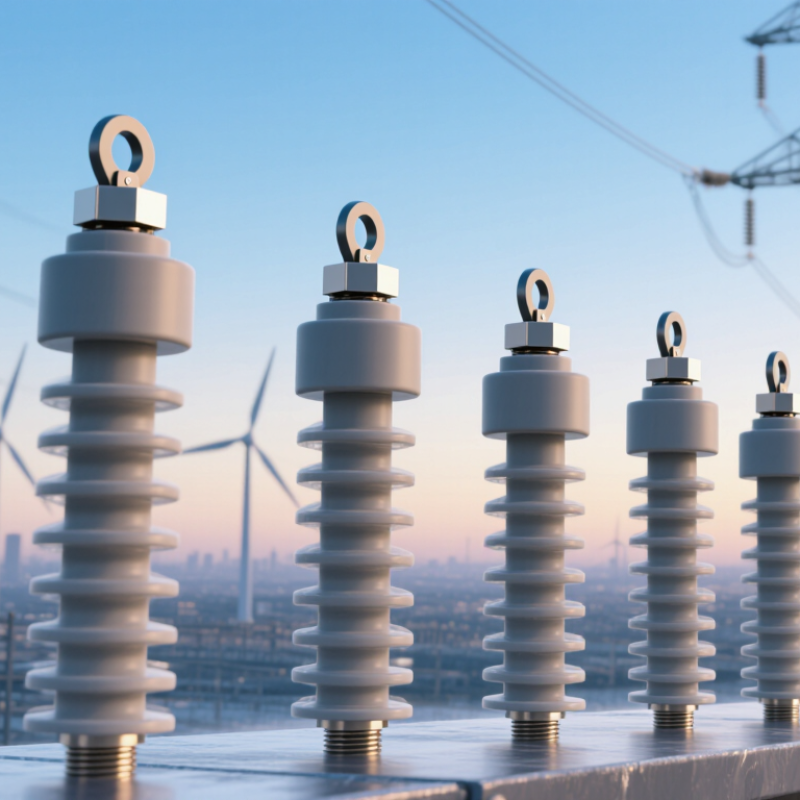
| Global Standards and Product Classification |
| Primary product standard | IEC 60099-4 | Applies to metal-oxide surge arresters without gaps for alternating-current power systems. | Request a valid type-test report, routine-test procedure, nameplate data, and standard edition used for qualification. | Use this standard when IEC conformity is required for transmission, substation, and distribution applications. |
| North American product standard | IEEE C62.11 | Covers metal-oxide surge arresters for AC power circuits, including electrical characteristics and test requirements. | Confirm that the stated ratings, test terminology, and residual-voltage data follow the IEEE method rather than being directly compared with IEC-only data. | Use the applicable IEEE standard where the purchaser, utility, or local grid code specifies North American practice. |
| Application coordination guide | IEEE C62.22
IEC 60099-5 | Provides guidance for insulation coordination, arrester application, protective levels, and system overvoltage assessment. | Check the coordination study, equipment insulation level, switching-surge exposure, and temporary overvoltage assumptions. | Do not select an arrester from nominal system voltage alone; the complete insulation-coordination study is required. |
| Arrester technology | Gapless metal-oxide varistor design | Uses zinc-oxide-based nonlinear resistive elements to conduct surge current and limit overvoltage without a series spark gap. | Verify the varistor element design, internal grading arrangement, sealing method, and protection against moisture ingress. | Gapless construction is commonly selected for fast response, predictable protective characteristics, and modern substation applications. |
| Housing material | Polymer or composite housing | Typical housings use silicone-rubber or other qualified polymer insulation systems mounted over an internal arrester assembly. | Review housing material qualification, tracking and erosion performance, hydrophobicity behavior, UV resistance, and aging test evidence. | Polymer housings are generally preferred where low weight, contamination performance, and reduced breakage risk are important. |
| Electrical Ratings and Performance Data |
| Maximum continuous operating voltage | Uc / MCOV | The highest RMS voltage that may be continuously applied across the arrester under specified operating conditions. | Confirm the value for the actual system voltage, grounding method, neutral displacement, harmonic content, and operating tolerances. | Uc or MCOV must not be lower than the maximum continuous phase-to-earth voltage at the installation point. |
| Rated voltage | Ur | The manufacturer-declared reference rating associated with the arrester's temporary-overvoltage and operating-duty capability. | Check the relationship between Ur and Uc/MCOV in the applicable standard and confirm the stated TOV withstand duration. | Do not use Ur as a substitute for system insulation coordination or as the only basis for choosing an arrester. |
| Nominal discharge current | 8/20 μs current impulse | Common application classes include 5 kA, 10 kA, and 20 kA nominal discharge current, depending on voltage level and duty. | Confirm the current magnitude, impulse waveform, polarity, tolerance, and test standard. Verify that the value matches the prospective surge environment. | Higher nominal discharge current can be appropriate for exposed transmission, substation, or high-lightning-density locations, but it does not automatically mean better protection. |
| Line-discharge or energy capability | IEC line-discharge class or equivalent energy specification | Used mainly for higher-voltage arresters to represent energy stress from switching surges and line discharges. | Request the declared class or energy capability, test circuit details, thermal recovery evidence, and maximum energy per discharge where provided. | For EHV and long-line applications, energy capability and thermal stability may be more critical than nominal discharge current alone. |
| Residual voltage | Protective or discharge voltage level | Voltage developed across the arrester during specified impulse currents, commonly including steep-current, lightning-current, and switching-current tests. | Compare values at the same current waveform, front time, polarity, and measurement method. Ensure the protective level is compatible with the protected equipment's insulation level. | Use like-for-like test conditions; residual-voltage values from different standards or waveforms should not be compared without normalization. |
| Temporary overvoltage capability | TOV withstand | Ability to withstand temporary power-frequency overvoltage for a specified voltage magnitude and duration without thermal runaway. | Obtain the TOV curve or tabulated data, including initial temperature, prior energy exposure, duration, and grounding assumptions. | Evaluate faults, load rejection, ferroresonance, neutral displacement, and other system events that can raise phase-to-earth voltage. |
| Short-circuit or pressure-relief capability | Internal-fault safety performance | Designed to manage internal arrester failure and reduce the risk of explosive fragmentation under specified short-circuit conditions. | Review pressure-relief, short-circuit, enclosure-failure, and safe-failure test reports for the intended housing and mounting configuration. | Especially important in substations, indoor installations, densely populated areas, and locations with high available fault current. |
| Testing and Quality Documentation |
| Type or design tests | Applicable IEC or IEEE product standard | Normally address electrical performance, operating duty, insulation, environmental durability, mechanical integrity, and safety-related behavior. | Request complete laboratory reports rather than certificates alone. Confirm test sample construction, ratings, test sequence, acceptance criteria, and laboratory accreditation. | Type-test evidence should cover the same electrical design, housing family, grading system, and manufacturing process as the offered product. |
| Routine production tests | Factory acceptance and production control | May include reference-voltage measurement, leakage-current checks, sealing checks, visual inspection, and other tests required by the applicable standard. | Request routine-test records or a batch test plan, including serial-number traceability and acceptance limits. | Routine tests confirm production consistency but do not replace full type-test evidence. |
| Reference voltage and leakage current | U1mA and operating leakage-current measurements | Reference voltage and leakage behavior help verify the nonlinear characteristics and production consistency of the metal-oxide elements. | Confirm measurement current, test temperature, instrumentation accuracy, element grouping, and whether results are recorded for every unit. | Use trend analysis and batch limits to identify manufacturing variation; avoid using one leakage-current value as a universal acceptance limit. |
| Long-duration current impulse | Energy and thermal stability test | Assesses the arrester's ability to absorb specified surge energy and recover thermally under defined long-duration impulse conditions. | Check impulse duration, charge, energy, number of applications, preconditioning, cooling interval, and post-test leakage criteria. | Important for switching-surge exposure, cable-connected systems, capacitor banks, and high-voltage transmission installations. |
| Operating-duty test | Lightning impulse plus power-frequency stress | Evaluates stable operation after prescribed impulse applications and temporary overvoltage exposure. | Verify that the test includes the declared Ur, Uc/MCOV, impulse current, TOV duration, and final thermal-stability assessment. | Use the test data to confirm that the arrester can recover under the actual fault and surge sequence expected in service. |
| Environmental and aging tests | Weathering, moisture, pollution, and temperature cycling | Assesses resistance to UV exposure, humidity, thermal cycling, salt or industrial contamination, tracking, and erosion. | Match the test severity to site conditions, including coastal salt, industrial pollution, desert dust, tropical humidity, and high solar radiation. | Choose the required creepage and housing performance from the site's pollution severity rather than from voltage rating alone. |
| Mechanical and seismic tests | Terminal load, cantilever load, vibration, and seismic qualification | Verifies that the arrester withstands conductor loads, installation forces, transport vibration, and specified seismic demand. | Confirm the rated static and dynamic loads, mounting orientation, terminal arrangement, center of gravity, and seismic response spectrum. | Critical for high-voltage substation structures, earthquake zones, and installations with rigid busbar connections. |
| Installation and Environmental Selection Criteria |
| System voltage and grounding | Nominal voltage, highest system voltage, and neutral treatment | Selection depends on maximum phase-to-earth voltage, fault duration, grounding impedance, and neutral displacement. | Provide the highest system voltage, grounding method, earth-fault clearing time, and expected temporary overvoltage profile to the supplier. | Incorrect grounding assumptions can result in an arrester with insufficient Uc/MCOV or TOV capability. |
| Insulation coordination | Protected equipment withstand level | Arrester protective levels must be coordinated with lightning impulse withstand, switching impulse withstand, and power-frequency insulation requirements. | Compare the arrester's protective level with the equipment insulation level, lead voltage drop, separation distance, and installation geometry. | Install the arrester as close as practical to the protected terminal and minimize lead length and loop area. |
| Pollution and creepage distance | IEC 60815 application principles | External insulation design should reflect site pollution severity, altitude, contamination type, wetting conditions, and required creepage distance. | Request creepage distance, arcing distance, profile design, pollution classification, and evidence of tracking and erosion performance. | Coastal, cement, chemical, mining, and desert sites may require enhanced housing geometry or increased creepage distance. |
| Altitude | Site elevation above sea level | High altitude can reduce external air insulation strength and affect clearances, corona behavior, and thermal conditions. | Declare the maximum installation altitude and request any derating, clearance correction, or special qualification requirements. | Do not assume sea-level clearance and pollution data remain valid for high-altitude installations. |
| Lightning and switching environment | Lightning density, line exposure, cable transitions, and switching operations | Surge frequency and energy depend on lightning activity, overhead-line exposure, cable length, transformer characteristics, and switching devices. | Review lightning ground-flash density, shielding, line length, cable interfaces, transformer location, and switching-surge study results. | Use system studies to determine energy duty and protective level instead of selecting solely by nominal discharge current. |
| Installation configuration | Phase-to-ground, phase-to-phase, neutral, transformer, busbar, and line-end applications | Electrical stress and lead inductance vary with mounting location and connection arrangement. | Confirm mounting orientation, terminal type, line and earth lead arrangement, isolation base, counter, and disconnector requirements. | Configuration-specific drawings should be approved before production, especially for transformer and GIS interfaces. |
| Commercial, Compliance, and Lifecycle Criteria |
| Traceability | Serial number and batch control | Each arrester should be traceable to production date, material batch, electrical test results, and final inspection records. | Request nameplate format, serial-number structure, manufacturing records, and retention period for quality documentation. | Traceability reduces warranty risk and supports replacement planning, failure investigation, and grid-asset management. |
| Documentation package | Technical file and approval documents | Typical documents include datasheet, outline drawing, wiring or mounting diagram, test reports, installation manual, and maintenance guidance. | Ensure documents state ratings, test standard, environmental limits, torque values, storage conditions, lifting points, and disposal requirements. | Require all documents in the purchaser's contractual language and use controlled revisions for project approval. |
| Conformity and market access | Applicable national and project requirements | Projects may require IEC or IEEE compliance plus local utility specifications, electrical safety rules, import documents, or conformity declarations. | Identify mandatory requirements before tendering and verify whether certificates apply to the exact product rating and housing configuration. | Certification logos alone are insufficient; verify scope, validity, issuing body, test sample, and standard edition. |
| Warranty and service life | Operating environment and expected service period | Service life depends on electrical duty, contamination, UV exposure, moisture sealing, thermal stress, and mechanical loading. | Review warranty exclusions, inspection recommendations, replacement policy, spare-part availability, and failure-reporting procedure. | Compare total lifecycle cost, not only purchase price, particularly for remote substations and difficult-to-access line locations. |
| Recommended buyer decision sequence | Technical compliance before commercial comparison | 1. Define system data; 2. perform insulation coordination; 3. establish Ur and Uc/MCOV; 4. determine energy duty; 5. specify environmental and mechanical requirements; 6. evaluate documentation and cost. | Use a compliance matrix with pass, deviation, and clarification columns for every mandatory requirement. | A technically compliant arrester with complete evidence should be compared before evaluating price, delivery time, or optional accessories. |